Thursday, May 2, 2013

"Prostitution: Behind the Veil"

Prostitution: Behind the Veil, 2004

Dir.: Nahid Persson
Prod.: Jakob Hogel, Nahid Persson

OK I know it's been a long time - almost a year - since I last posted. I promised I would come back and to be more devoted, then I made one post and poof! There I go again. Frankly, I am ashamed I couldn't make the commitment. But, to be fair, at the same time I was aiming to come back, I was planning my wedding. Yup! I got married in September! Go us! It wasn't easy but we had a lot of help from friends and family and we had a great day. 

Anyway, I really, really want to get back into this project of documenting documentaries (har-dee-har-har). I really do love the genre and there's just so many, on so many different subjects! Last time I tackled a pretty lighthearted subject with God Is the Bigger Elvis. This time, I have a bit of a darker subject to tackle: the state of women in Iran. 

Filmmaker Nahid Persson was born in Iran, however she escaped to Sweden in 1982 when Islamic fundamentalists took control. Seventeen years later, she returned, shocked to discover poverty was rampant and social justice had deteriorated. 

Iran used to be one of the most liberal Muslim countries. Now, however, the Koran is considered law, and religious infractions are considered crimes, punishable by imprisonment, torture and execution. 

In Prostitution: Behind the Veil, Persson chronicles the struggles of two women she meets quite by accident during a visit to Iran. The film is narrated by Nahid Persson herself. She first meets Habib, a man who works as a fortune teller using parakeets. Yes, parakeets. Apparently this is a really common thing! The guy sets a parakeet down and the bird picks a fortune out for you and you pay for it. I kid you not! 


This is not a screenshot from the documentary but it's the closest thing I could find. 

Anyway, Habib is run off the street corner he is fortune-telling on by the religious police and Persson and her crew end up following him home. Habib lives in a tenement building with ten other people with no running water or toilets, just a water pump in the courtyard. While there, Persson meets Fariba and Mina, two young women in their early-to-mid 20s, with a child each, who make their living through prostitution. 

They live in tiny rooms with barely any furniture and rags covering the windows. There are no locks on their doors. They have no beds but instead sleep on the floor with their children. They casually chat as Persson films and Mina threads Fariba's eyebrows, which are as thick and unruly as Frida Khalo's. 

They talk about sex and what they do to make a living, but also about the guilt and shame they feel. They talk about their methods of birth control - condoms are preferred, because they protect them against diseases (they are both fond of flavored condoms). Persson explains that when Islamic power rose in Iran, they banned all contraceptives. Because of this, the population doubled within a short period of time. By the time the government realized their mistake and lifted the ban on contraceptives, it was too late and overpopulation was already a growing concern. Fariba also tells Persson that the religious police tend to look the other way when it comes to prostitution, and confesses that she herself has slept with the chief of the religious police, and he paid her $20. "He was rough," she adds."I didn't like it."

Later, as the girls smoke heroin together, Fariba pulls out a photo album and says she wants to "show that we didn't always live like this." 

Fariba was married to a young man from a respected, wealthy family. Her brother-in-law was a medical student. Her father-in-law was a literary professor. Less than a year before this interview, Fariba's husband was arrested for drug use, and sentenced to life in prison. Mina's story is shockingly similar. Her husband is also in jail, serving a 35-year sentence for smuggling, selling drugs and murder. He was the one who was responsible for getting Mina addicted to heroin. 

In the film, Persson introduces us to the concept of a sighe. It is something that is perfectly legal in Islamic Iran. It is when a man takes on an "extra" wife that he can later sell to another man for a profit. During the time of the sighe marriage, which is negotiated with a verbal contract and then sealed by a mullah (Islamic clergy), the woman must act as a wife must - she must cover her head, ask her husband for permission to leave the house, and service him in bed. Sighe marriages can last any period of time, from ten minutes to 99 years, and the woman is often paid a fee for her participation. 

Habib, the parakeet fortune teller who is a man of about sixty, makes a sighe marriage of six months with a 17 year old girl that he'd only known for about ten minutes. Persson narrates that girls in Iran are married off as young as nine years old. It turns out that Mina has a sighe that she has a two-month contract with. She shows Fariba the marks on her body where he has cut, kicked and scratched her, and cries as she confesses he hits her 20-month-old daughter as well. 

One thing that I wished Persson covered more in the documentary was how Mina and Fariba solicit their customers. I know that sounds like an odd thing to say, but for a documentary called Prostitution: Behind the Veil, she does not focus very much on the actual profession of prostitution. She follows Mina and Fariba only one time each. Heartbreakingly enough, they are forced to bring their children with them as they solicit, since there is no one else to watch them. Fariba makes $5 off a cabbie, who forces her to buy condoms from a nearby pharmacy because "it isn't right" for him to do it himself. He allows Persson to film him as he drives and haggles over price with Fariba, telling her that he wants people to see that Iran has gone to hell. Mina picks up two young men in a car who pay her $10 each. They drive her and her baby to their apartment. She hands the baby off to one of the men as she goes into the bedroom with the other. "When he's done, you can come in," she says, flicking her head scarf over her shoulder. 

Persson reflects more on the concept of sighe marriages and the religious power oppressing the women of Iran more than the actual act of prostitution and how so many women fall into that trap. She mentions how grateful she is that she can return to Sweden where she has opportunities, and women in Iran cannot and do not. 

There was really no moral or message to this documentary. Persson does include an epilogue about Fariba and Mina, but the information is sparse. I wish she had gotten more interviews with more prostitutes. She does manage to talk to Fariba's sister-in-law and mother, but no one from Mina's family. I would have liked a little more background on the girls. 

Though I was intrigued and saddened by the information I learned in the documentary, I really wish it had a little more meat on its bones. It did make me grateful that I have grown up in a country where I am not considered property, and where I can get an education and vote and make my own choices. Persson made it very clear that she was glad she left when she did. But I feel like the film lacked something, and it was probably more stories, but I thank Nahid Persson for making this film and showing us what is going on in other parts of the world that we have no idea about.

Thursday, July 26, 2012

"God Is the Bigger Elvis"

God Is the Bigger Elvis, 2011

Dir.: Rebecca Cammisa
Prod.: Sheila Nevins, Julie Anderson, Rebecca Cammisa


A few months ago, my best friend Meredith allowed me to use her HBOGO account, and I couldn't thank her enough. HBOGO is like Hulu, except it is exclusively HBO programming - movies, series, and, of course, documentaries. One of the first things I did when I gained HBOGO access was scope out their documentaries section, and boy oh boy did I have a field day. The one that grabbed my attention first was the Oscar nominated short documentary God Is the Bigger Elvis, which had a screen cap of a smiling nun, her arms outstretched, Julie Andrews-style.

First of all, what an awesome title. Second, I think nuns are great. I don't know why, exactly. Maybe that's due to my early love of The Sound of Music, maybe it's because my mother took me to see Sister Act when it first came out in theaters, maybe it's because those calendars of "Nuns Having Fun" crack me up. 

It was all fun and games until Sister Ruth rear-ended the Mother Superior

Whatever the reason, I think nun culture is fascinating. I mean, these women give up everything - their families, their social lives, their fashion tastes - to serve God. They come from so many different backgrounds, but all came together for their mutual love of God. It's a pretty groovy thing, if you ask me.


Though only a half-hour long, God Is the Bigger Elvis manages to tell a beautiful, moving story – one of Dolores Hart, an actress from the '50s and '60s who had performed alongside the biggest heartthrobs of the day: Montgomery Clift, Cary Grant, Marlon Brando, Warren Beatty, and yes, the King himself. In her mid-twenties, she gave it all up, broke off her engagement, and became a nun at the Abbey of Regina Laudis in Bethlehem, Connecticut - an enclosed Benedictine monastery and working farm. It's the only one of its kind in the United States.

Now known as Mother Prioress Dolores Hart, she still currently resides there, one of 36 nuns who follow strict Benedictine guidelines. They pray and sing 7 times a day, observe 3 periods of silence a day, and work on the farm. Mother Prioress takes appointments to speak to people who come to the monastery about their suffering, and help them find hope in dismal situations. She also enjoys bird watching, listening to opera and spending time with her African Grey parrot, Toby. She also spends time personally answering fan mail that she still receives daily.

Dolores was a blonde, blue-eyed bombshell back in her day. She was nineteen years old when she was offered a seven year studio contract. She acted in ten films, including Loving You, Lonelyhearts and Where the Boys Are. Dolores has zero regrets about quitting her acting career. “I never felt I was leaving Hollywood. I never felt I was leaving anything that I was given. The abbey was like a grace of God that just entered my life in a way that was totally unexpected, and God was the vehicle,” she pauses here and gives a big smile. “He was the bigger Elvis.”

Her first encounter with the Abbey came when she was acting on a show on Broadway in the late fifties. Dolores was experiencing fatigue, and a friend suggested she go to the Abbey to recuperate. Hesitant at first, she soon fell in love with the peacefulness of it all. During her time there, she met with the Reverend Mother. 

“The concern that I had was that it was wrong as a Catholic to be in the movies because, sexually, you could be aroused by boys and you could get involved sexually with men…and the leading star was Elvis. She said, ‘Well, why not? You’re a girl! Chastity doesn’t mean that you don’t appreciate what God created. Chastity says, ‘Use it well.’ I came away with a sense of peace.”

After she returned from the abbey, Dolores became engaged to Don Robinson, a young architect. To my delight, Don Robinson is interviewed in this documentary. He speaks nothing but kind words about Dolores. In the midst of planning a wedding and building a house and a life together, on the night of their engagement party in 1963, Dolores tells Don she does not want to get married. She was going to Regina Laudis to take her vows.

God Is the Bigger Elvis also interviews other nuns that live alongside Dolores Hart, offering perspective of her as a Mother Prioress and the pillar she is to her abbey. One of the most terrific things about Dolores Hart is that she truly is a wonderful woman – you can absolutely see why Hollywood was mad for her. Though she is no longer the blonde pinup model she was in 1960, her charm and wit shines through, even though she is dressed in a nun’s habit. She has a smile and a kind word for everyone. 

The best part about this documentary was that I smiled the entire time I watched it. If you have a half hour to spare and are looking for a great, fuzzy documentary filled with nuns having fun, try to get your hands on God Is the Bigger Elvis.

Quiet on the Set ... I'm Coming Back!

Hello, movie lovers - or whomever reads this blog. I'm so sorry I stopped updating here, and I've missed it terribly. I have NOT stopped watching documentaries, though! I've watched several that I'm actually going to go back and watch again because I kept meaning to write reviews but never got around to it.

Here's the situation: since I started this blog, I've been hired and fired from two different jobs. Because of this, I suffered from a bought of depression that caused me to not want to do anything other than lie in bed and feel miserable. However, I eventually picked myself up, brushed myself off and began to do what I do best - watch documentaries.

Now, I am working a job I absolutely adore with a great company. I only work 4 days a week (10 hours/day), which leaves me with 3 glorious days to do nothing. So, I decided I'm going to try to watch at least ONE documentary a week so that I can get back on this horse.

Sometimes, there's nothing like watching life unfold before your very eyes to help you realize things can be so much worse.

Let's get this show back on the road.

Friday, August 5, 2011

"Mine"

Mine, 2009
Dir.: Geralyn Pezanoski
Prod.: Alison Pezanoski-Browne, Erin Essenmacher and Geralyn Pezanoski
This will forever change our lives. As pet guardians, as parents, our lives will be forever changed – New Orleans resident. 
I avoided this documentary for the same reason when my mom brought home the DVD of Marley & Me, it sat unopened for nearly six months.
Because, Mom,” I stressed when she asked me for the umpteenth time why we hadn’t watched it yet, “I know for a fact that I am going to cry uncontrollably.”
It’s like a sickness. I know that any movie or TV show involving a dog or the plight of a dog is almost inevitably going to make me cry. I have two dogs, a mutt and a terrier, who are my best friends (other than, you know, my fiancĂ©). I don’t live with them anymore, my mom has them. When she told me she was moving to Arizona and taking the dogs with her, I began to cry. “Don’t worry,” Mom said. “We’ll still call each other and you can come visit anytime.”
“I’m not crying about that! I’m crying because you’re taking away my dogs!” I wailed, much to my mother’s chagrin.
As much as I cannot wait to adopt a dog of my own, I am dreading the process – there are so many dogs who need homes, so many that deserve loving families. How can I choose just one? On top of that, I work at an animal lodging facility where I spend eight hours a day, four to five days a week as a companion for dogs whose very rich owners have kenneled them while they go on business trips or vacations. I often find myself wiping away tears when I put them back in their enclosures, not wanting to hear their high-pitched whining as I lock their doors. Also, my fiancĂ© knows better than to let me anywhere near an animal shelter or a pet store, because I will want to take all the dogs home. I'm also the type of person who will quickly change the channel in order to avoid watching the ASPCA commercials featuring all the moon-eyed dogs wanting a sponsor. Aaaagghhh my eyes are watering just at the thought of those damn commercials.
According to the synopsis on the documentary’s website (minemovie.squarespace.com), “Mine is…about the essential bond between human and animals, set against the backdrop of one of the worst disasters in modern US history [Hurricane Katrina].”
I was going to avoid watching this film as much as possible. Maybe save it as the last one off my list. But I didn’t want to postpone the inevitable. I found myself actually needing a good cry, so, I put it on.
The film opens to a montage of Hurricane Katrina wreckage from August of 2005. While rescue personnel were concerned with evacuating the people of New Orleans, the people were dismayed that they were being forced to abandoned their pets. Shelters were refusing to accept people with animals. Therefore, pet owners had no choice but to leave their beloved pets behind. After the city began to return to normal, pet owners were faced with the task of trying to track down their beloved furbabies.
Mine focuses on five people and their difficulties with reclaiming their dogs in the aftermath of Katrina. There are also interviews with the dog foster parents, ASPCA workers and rescuers, and animal rights activists. Director Geralyn Pezanoski does a miraculous job recording the emotional pain, joy and outrage of all involved.
In the aftermath of Hurricane Katrina, and later Hurricane Rita, 150,000 animals died. Those that were found alive were rescued and shipped out. This project, known as Operation: Orphans of the Storm, sent 15,000 pets to 500 shelters across the US and Canada. They were all catalogued and listed on Petfinder, then word was put out that owners could find their missing pets online.
Rescuer Jane Garrison was met with skepticism when she told people she was going to New Orleans to rescue animals. She was asked, "Why are you saving dogs? Why aren't you saving people?" She was shocked when she saw footage of Katrina's aftermath and news crews were abandoning the dogs they filmed. She saw people being rescued off of building rooftops, and the dogs being left behind. She explains, "None of the groups were ready for the disaster of this magnitude...I couldn't get enough people down there each day...As long as you weren't from the area, you could come down and help." Cameras follow her as she and her team search neighborhoods. They find several houses were spray painted to let rescuers know that animals were inside. They discover dogs locked in cages, trapped in destroyed homes.
Karen O'Toole, another rescuer, says of the disaster: "I knew it wasn’t a matter of sending a check to the Red Cross. I thought I was watching a movie when I saw Katrina on TV. You couldn’t rely on the government in a disaster like this."
For what it's worth, many, many efforts were made for the sake of the animals. Temporary shelters sprung up. Every cat and dog found were given medical care, vaccinations and microchips. "The first priority was saving their lives," Jane says. "The next was finding their families."
Malvin, a man in his mid-eighties, left his miniature poodle Bandit in his New Orleans home when he was told to evacuate. He left Bandit with food and water and a promise that he would return in a few days. "When the levees broke," Cavalier says, "I thought, Lord have mercy. What about Bandit? Where’s Bandit?" After living as an evacuee for eight months in Houston, Malvin recieves his FEMA trailor, and, eventually the help of an organization known as Stealth - their mission being to reunite Katrina dogs with their owners.
When Linda was evacuated with her family, she left fifty pounds of food and lots of water for her German shepherd, Precious. She begged rescuers to save her dog, but her plea fell upon deaf ears.  
Victor returned to New Orleans to find his dog, only to discover he'd been adopted by another couple named Tiffany and Jeremy, who were told that the original owner of Max "didn't want him back." Of course, Tiffany and Jeremy are shocked to discover that not only did Max's original owner wanted him, but never consented to an adoption. A pet custody battle ensues, leaving both parties fighting to call Max theirs.  
Jessie, a hard working man, had to leave behind his four-legged son J.J. (which stands for "Jessie Junior") during Katrina while he and his family were evacuated, and has since spent many, many months trying to locate him, only meeting with dead ends, false hope and lies. 
Finally, we are introduced to Gloria and her Labrador Murphy, her best friend. Gloria was "forcibly rescued" from her home during Katrina, because she refused to leave Murphy behind and be separated from him. Rescuers ignored her requests to save Murphy. Her devoted daughter scours the internet, looking for her mother's dog in a chaotic aftermath. 
I initially wrote six pages, single spaced, on this film, but I’ve decided to cut it down to save me from myself. However, I am thrilled to report that in the wake of Hurricane Katrina, Congress passed the Pets Evacuation and Transportation Standards (PETS) Act, requiring states to accommodate pets in their disaster evacuation plans so that something like this will never happen again.
After the film ended, I sat on my couch, buried my face in a pillow and cried for a good five minutes. I cried for Malvin and Bandit; for Linda and Precious; for Victor, Tiffany, Jeremy and Max. I cried for Jessie and J.J.; I cried for Gloria and Murphy. I cried for the dogs that didn’t make it. I cried for the dogs that found new homes and were reunited. I cried for the owners who have lost their best friends. I cried for the fact that I could not hug my own dogs.
If you are a dog lover, a dog owner, a friend of a dog, I highly recommend Mine. Don’t be embarrassed to cry, seriously – even if you’re not a waterworks like me. These are stories that are altogether heartbreaking and uplifting, happy and sad.

Wednesday, July 20, 2011

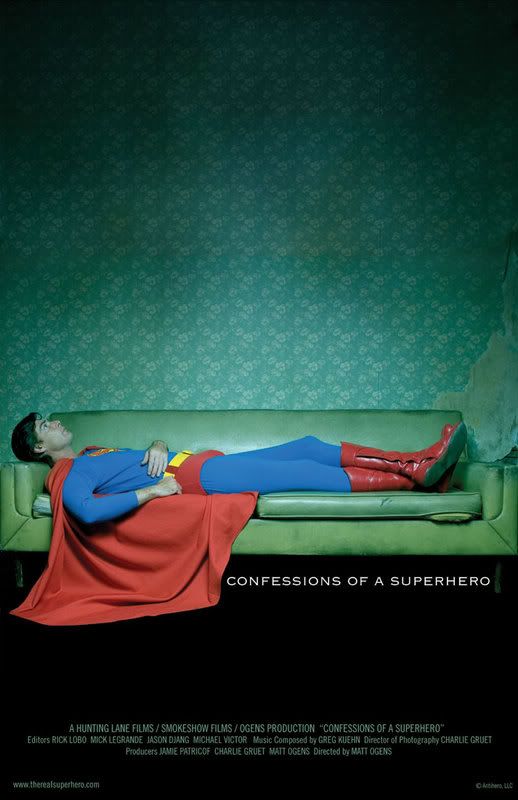
"Confessions of a Superhero"

Confessions of a Superhero, 2007
Dir.: Matt Ogens
Prod.: C. Shawn Bennett, Jordan Ehrlich, Charles Gruet, Elizabeth McIntyre, Mark Meyers, Matt Ogens, Spencer Parker, Jamie Patricof and Zev Suissa.

Every morning, Christopher Lloyd Dennis brushes his teeth, washes his face, styles his hair and dons his uniform for work on Hollywood Boulevard: a uniform that consists of tights and a cape.

Dennis is one of many who make their living by dressing in costume and posing for pictures with tourists in Los Angeles, California. Rain or shine, winter or summer, they are all there - characters ranging from Jack Sparrow to Marilyn Monroe to Spiderman - working for tips while waiting for their big break. 

Matt Ogens focuses on four of these hard working individuals as they dedicate their lives to  becoming famous - regardless of the cost to their home lives and own mental well-being.

The subjects of this documentary are, of course, Dennis, who was the first Superman on Hollywood Boulevard; Max Allen who dresses as Batman and deals with intense anger issues; Jennifer Garrett, the Tennessee-born pastor's daughter, also known as Wonder Woman; and Joe McQueen, who lumbers around in a large, bulky Incredible Hulk costume.

The film also has a few interviews with the beat cops who stroll Hollywood Boulevard, making sure that the characters are respecting the line between public and private property and aren't terrorizing the tourists. Their job is mostly benign, and a few of the cops actually get to know the regulars - asking how their kids are, how their day is going and if they've had any auditions lately.

I had seen the costume characters on television and movies that take place in Los Angeles, but I always thought that these were either professional extras or hired by movie studios for promotional purposes. But this is quite the opposite. These costume characters are mostly independent workers, accepting tips from tourists. They are not allowed to approach people and ask if they want a picture, and then demand payment - that is considered panhandling. Therefore, they have no control over their take of the day. "On a bad day," Jennifer Garrett says, "I will make thirty dollars. On a good day, I will make $150 an hour."

Confessions of a Superhero is as light as it is dark. While it seems like fun to learn about the people who sped their days dressing up as superheros and popular characters, it turns out that most of them - or at least the ones featured in this film - are pretty miserable. Well, not really miserable, but they do have their troubles.

Christopher Dennis, for example, calls himself a "historian of Superman and keeper of artifacts". His girlfriend, who studies psychology, calls him "obsessive". Shots of his apartment show that it is covered from floor to ceiling with Superman memorabilia, toys, posters and figurines - an estimated $90,000 worth of merchandise.

Max Allen, who once worked as a George Clooney impersonator, has a history of violent behavior and may or may not have been involved with the mafia. His past jobs also include stunt driving, boxing, and bodyguarding. He holds several black belts and has received Special Forces training. He attends anger management therapy, in full Batman costume. The cops have been called on him for scaring people, and aggressive begging.

Jennifer Garrett dropped out of college to move to Los Angeles and become an actress. On her fourth day in town, she met a man at a seminar. Two weeks later, they were married in Las Vegas. However, after several years, their marriage is quickly disintegrating. She admits that their spark is gone and he no longer excites her. At one point in the film, Jennifer has a meeting with her talent agent, who refers to her as a "sexy, curvy woman", though Jennifer is no more than a size eight.

Joe McQueen sold his video game system to buy a one way bus ticket out of North Carolina to Hollywood. He dealt with homelessness for four years while struggling to make it as an actor. He admits that he loathes dressing up as the Hulk on Hollywood Boulevard. "I feel like a loser. I didn't come out here to...make chump change."

The four performers constantly struggle with being in the position that they are in. The only one who seems content with themselves is Christopher. He really commits to his role as Superman, addressing the tourists as "citizens", lecturing a man dressed as Spiderman for smoking in front of the tourists. "Superheros don't smoke," he says. One Marilyn Monroe complains to him that she has not made one dollar all day, and Christopher reminds her that "tipping is not mandatory". On record heat days in Los Angeles, Christopher invites Jennifer back to his apartment so that they can soak themselves and their costumes in cold water. Meanwhile, the temperature reaches 130 degrees inside Joe's Hulk costume.

During the time that this movie was being filmed, two costumed characters made news headlines after they were arrested for aggressive begging. Footage of "Elmo" and "Mr. Incredible" being handcuffed and shoved into the back of police cars were all over YouTube and local news outlets. While the publicity did a lot for the other costumed characters - some were raking in thousands of dollars a day in tips - they became more on edge. Undercover police officers took to walking Hollywood Boulevard to make sure that the performers were complying with the rules. However, it turned out to not be much of a problem. Late night talk show hosts were clamoring to get them for interviews. Magazines and newspapers ran articles on them. Christopher Dennis  was even featured in a coffee table book about the performers on Hollywood Boulevard.

I had mixed feelings about Confessions of a Superhero. I thought it would be more of a lighthearted romp about people who get to live out their childhood fantasies by dressing up as their favorite characters/celebrities. But, like the superheroes that these actors portray, their lives aren't picture perfect. Max Allen is just as troubled and dark as Batman. Christopher Dennis struggles to find his place in the world, like Superman. It's almost as if the costumes reflect their own psychology. Director Matt Ogens did a fair job of portraying the struggles of the Hollywood Boulevard character actors. It wasn't my favorite documentary and it did drag a bit, however, if you're interested in a really fascinating stance on comic book characters/superheroes and psychology, this is what you'd want to watch.

Saturday, July 16, 2011

"Fagbug"

Fagbug, 2009
Dir.: Erin Davies
Prod.: Susan Coscione, Erin Davies, Jennifer K. Persons

In the mid-1990's, Eve Ensler wrote a monologue about the word "cunt" for her play, "The Vagina Monologues". The goal, she explains, was to reclaim a lovely word, despite its negative connotations. Following an unfortunate incident in 2007, Albany college student Erin Davies aimed to do the same thing with the word "fag".

In April of 2007, as she was leaving for work, Erin discovered that someone had spray painted the word "fag" on the driver's side window of her gray Volkswagen Beetle, and "U R GAY" on the hood, with red spray paint. Erin, an out lesbian, is visibly upset, shocked and embarrassed at the vandalism. The police refuse to recognize it as a hate crime, and her insurance company will not pay to have the graffiti removed. So, despite the warnings from her girlfriend, her mother and her brother, Erin decides to leave the graffiti on the car.

When she arrives to work on her college campus later that day, she is asked to move her car away from the general population, in case other people are offended by it, and to prevent any more vandalism. Erin refuses to move her car.

At first, everyone is supportive of Erin's decision to leave the graffiti. She recieves positive messages on her blog, on her MySpace page, and on her voicemail. After gaining media attention for driving the graffitied car around Albany and marching in Albany Pride, Erin decides to take a cross-country road trip in her "Fagbug", to promote awareness and speak out against hate crimes and homophobia. After raising over $800 for her trip, several of her friends turn their backs on her, insisting that the money Erin has raised should go to a charitable organization, not to pay for a "summer vacation". They tell her that by keeping the money, she doesn't help anyone but herself.

This I did not understand. Erin raised money so that she could promote awareness. It's not like she was doing this for fun. She

Shortly before her trip, someone removes the word "fag" from her window using what she suspects is a razorbade while she is in a bar with friends. After some contemplation, Erin puts it back on. Without the word on the car, her mission falls flat. She cannot reclaim the word if it's gone.

Erin's road trip commences. She stops in Florida, where she speaks to the friends and family of Ryan Skipper, a young man who was murdered for being gay 35 days before Erin's car was vandalized. She also stops in South Carolina, where she is in time to attend a memorial service for Sean Kennedy, another young man who was beaten to death for being gay only 28 days after Erin's car was vandalized. She learns from those attending Sean Kennedy's memorial service that South Carolina is one of three states that do not have hate crime laws.

Everywhere Erin goes, she obviously recieves attention - some good, some bad. People leave notes on her car, calling her an inspiration. Some even leave money. One woman even pays for her hotel room one night. Strangers share their own stories of discrimination, hatr crimes and homophobia, and thank Erin for her bravery. At one point, a note appears that reads: "It's a shame you made this up", and then a phone number at the bottom. Naturally, Erin calls the letter writer and asks to meet him. The man who left the note agrees to be shown on camera, and accuses Erin of doing the graffiti herself just to gain media recognition and make money.

Obviously that is maddening. Erin makes it very clear that her intention was never to make money and why, as a gay woman, would she ever vandalize her own car just for attention? That would be like me painting giant swastikas on the hood of my car.

Erin's trip has its ups and downs. Among the highlights: she has a rock thrown at her window in New Mexico, cracking her windshield. She recieved donations at San Diego Pride, and was asked to drive the Fagbug in the parade. Erin was informed that there was a group online called "Boycott the Fagbug", a group that was determined to shut down Erin's mission, claiming she was doing nothing to promote gay pride and that she was only a gimmick. Erin is also awarded Most Outstanding Individual at Vancouver Pride. 

One amazing turnaround happens when Erin recieves a call from someone at Volkswagen of America. They tell her that they want to sponor her, and reimburse her for gas and any car repairs. This just about floored me. You would think that a big corporation like Volkswagen would be dead set against a young lesbian driving all over the country with a pejorative word spray painted on her window and hood of one their models. Instead, Volkswagen embraced it! I wanted to cheer!

Erin meets another road tripper in Wyoming, a young man, and they happen to meet up again in another state. She asks him to participate in an experiment, and has him drive the Fagbug for a few hours. His experience was terrible, and the reactions were violently negative. He was pulled over by a policeman for having "profanities" on the car, and yelled at by passing cars.

Towards the end of her journey, in North Carolina, Erin pulls into a hotel and sees another car with the word "FAG" written on it. As she walks around the corner of the hotel, she spies a group of young men, all of whom are drinking. One of them recognizes Erin and calls her by name. How terrifying is that? When I heard this, I was terrified. I didn't want anything bad to happen to Erin - as my parents always used to tell me: cars are replaceable; people are not. At this point, I felt connected to Erin. I almost felt like she was my friend. I feared for her safety. Thankfully, Erin and the Fagbug survive the night, though she quickly leaves. Erin realizes that whether she likes it or not, her face has been in the media, and she very well may be a target.

Her prediction proves to be true. In Tampa, Florida, where Erin relocated, all four of the Fagbug's windows are smashed with a rock. Her neighbors suggest covering the car, but Erin decides against it.

After driving the Fagbug for a year, Erin decides to remove the graffiti. Courtesy of Volkswagen, she paints the bug in rainbow stripes (exactly like the Beetle that's on the poster).

Over the course of Erin Davies' crusade, she drove 55,00 miles across the country, htrough 41 states. She made headlines in 5 countries, interviewed 500 people, shot 110 hours of footage and documented 50 other hate crimes. Erin spoke at 25 schools, recieved 18 notes on her car, participated in 11 gay prides, had 7 people try to remove the graffiti and replaced 4 broken windows.

Fag is definitely one of those words that carries a heavy connotation. Much like the "N" word or the "C" word, fag is a slur that has also been used so very casually, without much thought as to the actual weight.

I absolutely adored Fagbug and Erin Davies. I admired her for her bravery and her determination to make others aware of the power of words. It made me want to go out and do something. It has been so long since I was active in the LGBTQ community, and this film has inspired me to become more involved. I was excited to discover that Erin is working on a sequel to Fagbug, which has yet to be given a title. I cannot wait to see it, and will review it as soon as I do! The sequel, exactly like the original, will be dedicated to "whoever vandalized my car". 

For more information on Erin Davies, her travels and the Fagbug, you can check out her website!

Friday, July 15, 2011

"Steal a Pencil For Me"

Steal a Pencil For Me, 2007
Dir.: Michele Ohayon
Prod.: Bryan O'Brien, Michele Ohayon, Theo van de Sande, Ted Sarandos, Jos van der Linden

"I'm a very special Holocaust survivor," proudly proclaims 93-year-old Jaap "Jack" Polak. "I was in the camps with my wife and my girlfriend; and believe me it wasn't easy."

Thus begins the romantic documentary of quite possibly one of the best and most unconventional love stories I have ever heard or seen on screen: the story of Jack and Ina Polak. At the time of the filming of this documentary, the happy couple, currently residing in New York City, were about to celebrate their 60th wedding anniversary.

As a Jew, I have a, shall we say, morbid fascination with World War II history, especially the Holocaust era. I am very fortunate that no one in my family had to live through the camps or experience Nazi occupation. However, I have always been drawn to this particular time in history. It's about the triumph of the human spirit, the determination to not roll over and die. Steal a Pencil For Me has both of these themes, along with stunning visuals and touching interviews with Ina, Jack and their friends, as well as beautiful narration taken from the letters Ina and Jack wrote to each other during the war. It's enough to make you sigh with longing.

In pre-war Amsterdam, Jack was an accountant. He fell in love with Ina, a diamond dealer's young daughter, at first sight when they met at a party. He wanted to marry her, but the problem was ... he was already married. He tried to divorce his wife Manja in 1941, but she said she did not want to. They were unhappy, but neither of them wanted to be alone.

This completely took me aback. I hadn't known going into this documentary that Jack was a married man, carrying on an affair with a woman nearly ten years his junior! This was about to get very, very interesting.

Director Michele Ohayon follows Jack and Ina's stories, painfully similar to others I have heard about this time period: they were dragged from their homes by Nazi officers, threatened with guns, their belongings were ransacked or sold. They were forbidden to own bicycles and radios. Ina recounts hearing about her neighbors committing suicide rather than be overtaken by the Nazis.

In July of 1943, Jack and his wife Manja were deported to Westerbork transit camp in Holland. Ina and her parents arrive two months later. Upon discovering this, Jack goes directly to the housing authority of Westerbork and asks to be placed in the same barracks as Ina - along with his wife.

This is either the smartest or dumbest man on Earth, I thought to myself. This is just asking for trouble.

"He won my heart by sheer persistence," says Ina with a smile. Even in her eighties, Ina is still a beautiful woman with apple cheeks and curly hair. She describes fondly how she and Jack would hold hands and take walks at night in Westerbork, until curfew. However, Ina kept her affair with Jack a secret from her parents, and she was concerned about hurting Manja. So, in order to keep their love a secret, they began writing letters to one another - beautiful, lyrical letters that professed their undying love for one another, how they would survive the war and be together forever. Jack would always address his letters to Ina with, "My dear little lady", and Ina would sign all of hers with "many kisses." Ina's sister would be their messenger, carrying the letters back and forth.

It seems as though every time I watch a Holocaust documentary, I learn something new. For example, in Steal a Pencil For Me, I learned what made the Westerbork transit camp unique. First off, a transit camp was, at first, a refugee camp for Dutch Jews trying to escape the Nazi regime. However, the inevitable happened - the Nazis took over, and turned Westerbork into a deportation camp. Basically, this is where Jews waited to be transported by train to either Auschwitz, Sobibor, Bergen-Belsen or Theresienstadt. What made Westerbork unique was, they had the modern conveniences. There was a sports arena, a hospital and very good schools. On Tuesday nights there was a cabaret. Those who taught at the school were Jewish teachers and professors who could no longer teach at public schools and universities. The doctors in the Westerbork hospital were Jews who were no longer allowed to practice in hospitals. This was all an illusion, however. Though the Jews who were interred at Westerbork were given all of this so that they would believe that Westerbork was not a bad place.

During a visit to Holland shortly before their anniversary, Jack and Ina visit Westerbork, which is now a memorial site and a museum, open to the public. While there, Jack encounters a group of Dutch schoolchildren on a class trip and takes a moment to share his wisdom and perspective on the Holocaust. He tells them there is no difference between a Jew and a non-Jew, a white man or a black man. "We are all born the same, we all die the same," he adds. 

Back in 1943, Jack and his wife Manja were deported from Westerbork to Bergen-Belsen. Three months later, Ina's name appears on a list to go to Auschwitz. However, at the last minute, her father pulls some strings and she is sent to Bergen-Belsen instead.

This is where Jack and Ina's letters take very dark turns. The flowery language is gone. Jack refers to himself as an "old man, getting older". Ina describes hunger pains, the misery of being unclean.  

While Jack is sent to do hard labor, Ina gets a job in one of the S.S. offices, taking minutes and German shorthand. This job kept her and Jack in paper and pencils so that they could keep writing their letters - at this point, these letters were keeping them alive. It gave them something to live for.

This is what I love about stories like this. Jack and Ina's love kept them alive. It was a little hard at first for me to accept this love, because, after all, Jack is still married. Manja is still alive, in the camps with Ina and Ina's sister. But the way they are so tender to one another in their letters, there is still a tiny spark of hope between the lines. Jack promises that they will get through this together, Ina suggests that they might move to America and start a new life. Despite all of the suffering around them, they still have a beautiful positive outlook on life, and are still deeply in love. It's incredibly admirable.

In 1945, when it was rumored that liberation was imminent, Jack and Ina exchanged their letters, so that they would both have the letters written by their own hand. This was Ina's idea, in case anything happened, and they would exchange them back once they were reunited. When the camps are liberated in April of 1945, the camp survivors were put on transit trains. Jack's train went East. Ina's train went to the West. They did not know where they were headed or if they would ever see each other again.

I was literally holding my breath the entire last few minutes of this documentary. It was obvious that both Ina and Jack survived, but I was dying to know how they'd found each other (of course, I will not spoil this ending for anyone who wishes to see the whole thing!).

Jack and Manja divorced, and then Jack married Ina. As of 2006, they have been married for 60 years. Together they have 3 children, 5 grandchilden and 2 great-grandchildren. In 2000, Jack and Ina's daughter Margrit published her parents' letters. Personally, I can't wait to track down the book - which is also titled Steal a Pencil For Me.

I really adored this documentary. Jack and Ina are the embodiment of Holocaust survival. Their love for one another them through one of the worst times in history. They had hope, they had faith, and they had each other. They persevered. Though at times their relationship was a bit hard to swallow, it being an affair, it's just too sweet to resist.